You will not find it difficult to prove that battles, campaigns, and even wars have been won or lost primarily because of logistics — Dwight D. Eisenhower
Technospirit Consulting can help you address your most complex support issues. Offering over 20 years experience in Support Solutions, Integrated Logistics Support (ILS) and Performance Based Logistics (PBL), across many tiers of the supply chain. From solution leadership on large prime Target Cost Incentive Fee (TCIF) arrangements like Chinook TLCS, to smaller tens of £m sub-tier supplier contract arrangements for major LRU. Rich Hartley was recognised as a Boeing Technical Lead Engineer, Designated Expert in Support Solutions, and Support Solution Strategy Lead for a 60+ ILS capability. A member of the MoD/Industry working group who wrote and delivered the inital issue of the ILS defence standard DefStan 00-600, he has both practiced and taught Support Engineering in depth across a variety of programmes and people. Few offer such experience in this field.
The wide variety of potential support requirements demands a flexible logistics structure tailored to theater missions - Joint logistics doctrine.
Integrated Logistics Support is a complex and multi-disciplinary subject requiring different fields of specialism, together with generalist skills and oversight. Whilst the specific elements and outcomes of ILS may require dedicated subject matter experts for certain fields, the tailoring and orchestration of a complete Support Solution requires width of knowledge and lived expertise. With an ability to tailor, sometimes from scratch, a solution that will perform. Being able to assess the problem, understand the pitfalls and tailor solutions that will endure is something Rich has repeatedly achieved. This includes assessment of existing systems and their transition or rationalisation into new services. All whilst proving with evidence that the solutions created are fit for purpose using appropriate supportability cases.
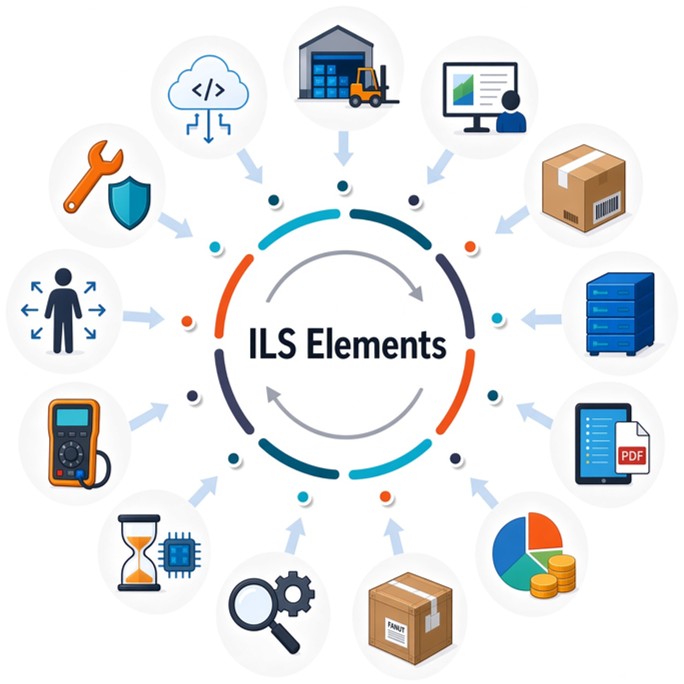
The following are examples of ILS elements from live projects successfully developed and delivered into service:
 A Boeing Designated Expert in Support Solutions, and Support Solution Strategy Lead for a 60+ ILS capability, Rich was overall solution lead on the successful TLCS2 £600m+ bid activity for UK Chinook. He also created the flight-hours pricing model for the ~£130m Chinook engine support arrangement (CESA), and led the small team of engineers who wrote the high value cost benefit analysis case and support solution whitepapers for the UK Chinook ER, shortly to enter UK MoD service.
 A crucial aspect of ILS is building support and improved through life cost into designs. Rich has worked extensively with customer stakeholders discussing and understanding requirements. Later infuencing design change, with examples including standardisation of hard-drives and processors from multiple specs to improve through life cost holding and availability, and maintainability improvements to equipment design on Land Vehicles for better in-field serviceability.
 A broad subject with several sub-specialisms, Rich fully explored the entire Line 1-4 repair chain for the Chinook Engine, building a successful digital model spanning L1&2 in the UK and L4 in the US. Familiar with the legacy JSP886 and more recent KiD(ILS), in earlier work he developed full Supportability Analysis (LSA), Maintenance Task Analysis (MTA) and Level Of Repair Analysis (LORA) for items such as virtual trainers and aircraft LRU. Later overseeing specialists within his team on LSA, RCM and R&M plus personally authoring Supportability Case Reports during solution development.
 As solution lead for the Chinook engine support arrangement, Rich co-created an end-to-end model of the engine supply chain in Extendsim, accurately predicting engine usage and repair turnaround needs and with that in-year repair costs and risks. The resultant in-service contract from 2013-18 proved the accuracy of the model. This early example of digital twinning allowed the programme to reduce the risk based pricing of the contract offering to within suitable confidence levels.
 Technical publications and tech data held in various ways are core deliverables within ILS. Rich has used and updated publications for both civil and military equipment, and supported the development of new ones. He has used and augmented UK military LSARs both on major packages and smaller tailored stores created within XL. Understanding the linkages between and the utility of different data sets. Rich also authored the original Data Exploitation strategy for Chinook within Boeing Defence UK.
 Familiar with both DefStan 00-600 and DefStan 81-41, Rich has supported the specifying of Special Type Containers and standard packaging for a variety of items within projects. Such as Engines, FLIR turrets, communications masts, ancillaries and various aircraft LRU.
 In one interesting example Rich was asked to assess the costs and availability implications of moving a crucial 3rd line repair facility from its current location into a new one. The legacy location repaired multiple equipment using a number of large old hydraulic test equipment and other more standardised methods. A full cost benefit analysis together with down time availability implications was performed to inform the business. Other work has included maintenance task analysis (MTA) for newly introduced LRU and specifying S&TE for on-site repair locations.
 Familiar with JSP822 and the DSAT method of Analysis-Design-Delivery-Assurance, Rich has worked on a number of training centric support offerings, and managed team members with specific qualifications and understanding of training techniques. Additionally he has developed several bids with training elements, and personally wrote and delivered a full course curriculum to train ILS engineers within Boeing Defence UK.
 Having created multiple support solutions and bid them into customers, the understanding of types and costs of different personnel and skillsets is well understood. Creating Basis Of Estimates first hand or pulling together larger estimates from sub-teams within the business, Rich has worked directly within maintenance organisations and with SMEs of most engineering types. Including design and development engineers, test engineers, repair techs, field service reps, ILS, and more.
 A varied subject matter for consideration in ILS, facilities can be complex. In one example Rich was seconded to work within the Babcock Team Aurora consortium for the Skynet Service Delivery Wrap. From a cold start developing a programme to assess and understand all equipment, buildings and facilities that would ultimately be managed, together with the risks of onboarding large legacy facilities and equipment. Other work includes work on Engine bays and various facilities at customer sites.
 Rich has worked on a number of IT and software centric projects, including virtual trainers and military digital communications. In one role leading the technical bid inputs to a number of support contracts for large UK MoD legacy software systems. This included provision and support of software test and reference rigs, call centre access, incident triage and resolution services.
 As originator of Boeing Defence UKs Obsolescence strategy and overseeing the proactive and reactive risk based approaches to Obsolescence Management on the Chinook platform, Rich is no stranger to OM nor the risk and resolution options. He is familiar with UK MoD Obsolescence expectations and the IEC 62402 Obsolescence Management standard. Additionally being a key author on the Chinook Sustain to 2040 programme, covering technology refresh and sustainment options for the fleet.
 Having spent over 2 years ramp side at Paris CDG aiport and over 10 years within the Chinook sustainment solutions, Rich understands the implications, costs and resolution methods of sustaining engineering first hand. Trained in both ILS and ITILv4, having worked alongside the on-call support teams within Boeing UK, plus lineside and depth maintenance teams within Air France, he understands the incident management aspects of software and hardware both in the UK and in theatre.
 Understanding in-service availability and reliability is of immense value, and there a number of techniques available. In the military air domain by example, information captured on LITS, GoldESP or other systems, if correctly captured, can be utlised. Rich has personally developed working systems to investigate on-platform failure cause and effect, with two notable examples delivering multi-£m savings for customers. He has analysed operational data, by example creating a proven engine support contract pricing model, and adjusted maintenance strategies and spares holding to optimise availability.
The supportability field is complex, containing multiple specialisms. It is often recognised by businesses and recruiters to have a marketplace skills shortage with a premium recruitment dynamic.
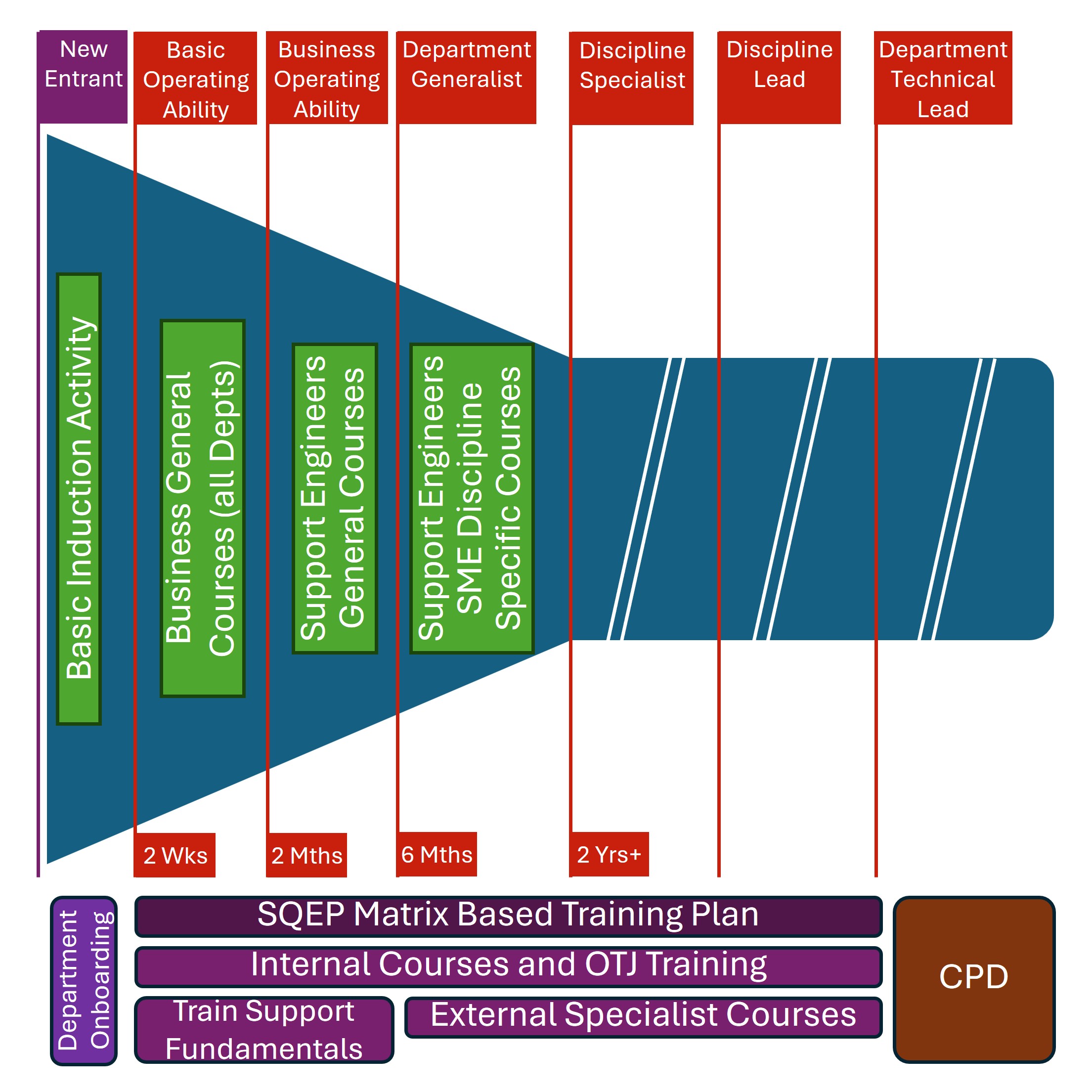
As with any capability it can be trained and strengthened over time, using the right framework, guidance and on-the-job experiences. Developed many years ago by Technospirit Consulting, the diagram to the right offers a viable route to take generic or new entrant individuals through to high levels of competence in any field. Used repeatedly now by Rich in his various leadership roles, this representation has been modified here to show a support capability example.
In 2022 Rich built and improved a team of 60+ ILS engineers, spanning all ILS elements. From a mixed starting point of mid level experience in some disciplines to some talent sourced from non-support backgrounds, Rich developed a full structured training package of in-house and external course content, delivering the in-house elements himself. This successful route to capability improvement initially included assessment of knowledge gaps, re-baselining of generalist subject knowledge and then specific targeted training in subjects such as RCM, R&M and Publications. The resulting outcome was a coherent and structured capability, with a depth of knowledge that could support and span mulitiple platform solutions into the future.